
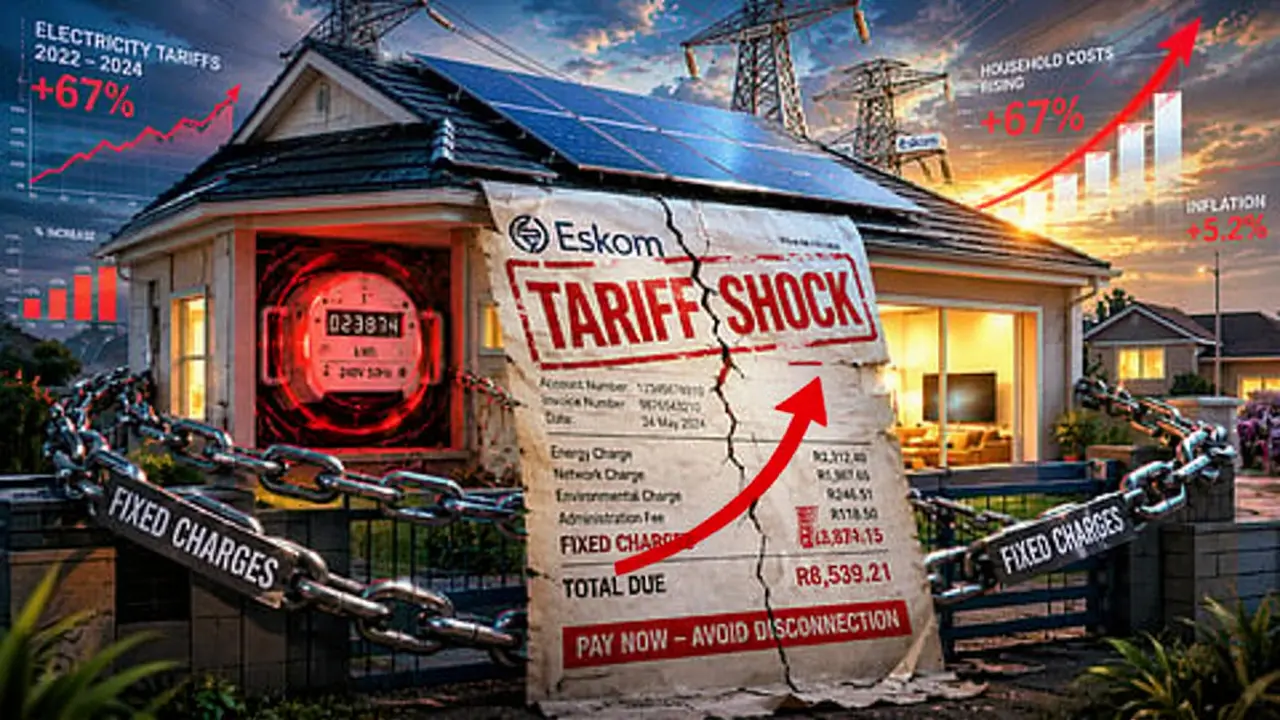
When Eskom unveiled its new residential electricity tariffs for the 2025/26 financial year, many middle-class households were caught off guard. The utility’s restructuring, approved by the National Energy Regulator (NERSA), takes effect on . While the headline average increase sits at a manageable 12.74%, the real story lies in the structural shift that penalizes low consumers and solar users with soaring fixed monthly charges.
Here’s the thing: you can install solar panels or cut your usage in half, but if your bill’s fixed component doubles, your savings vanish. This isn’t just about higher rates; it’s a fundamental change in how electricity is priced, moving away from pure consumption-based models toward flat fees that hit smaller households hardest.
The Myth of the Average Increase
On paper, a 12.74% hike sounds painful but predictable. But averages are deceiving. In the previous 2024/25 cycle, local authority tariffs saw an average rise of 12.72%, while direct customers faced 12.74%. However, the affordability subsidy charge jumped by a staggering 25.24%, dragging up industrial tariffs to 13.29%.
For 2025/26, the picture is even more skewed. Eskom has abolished inclined block tariffs—where the first kilowatt-hours were cheaper—for key residential categories like Homelight 20A, Homelight 60A, and Homepower 4. Instead, they’ve introduced flat energy rates. For low-consumption households using less than 350 kWh, the per-unit cost on Homelight 20A rises by 13.6%. On Homelight 60A, it jumps 18.3%. Meanwhile, high-volume users see their variable costs drop significantly, with Homelight 60A and Homepower 4 rates falling by over 30% for usage above certain thresholds.
This creates a perverse incentive: the more you save, the less you benefit. High users get discounted rates for bulk consumption, while frugal households pay a premium for every unit they do use.
The Fixed Charge Trap
The twist is the fixed monthly component. For tariffs like Homepower 4 and Homeflex 4, Eskom has introduced or increased standing charges that apply regardless of usage. From 1 April 2025, the fixed monthly fee for Homepower 4 will skyrocket by 88%, jumping from R192.90 to R362.70. That’s nearly double what it was last year.
Why does this matter? If you’re a small household or have rooftop solar that covers most of your needs, you might only buy 50 kWh from the grid. Under the old system, your bill would be tiny. Now, you still pay that R362.70 fixed fee before you even touch the variable rate. As one analysis noted, this structure "impacts low consumption customers the hardest." It effectively taxes efficiency.
Solar-equipped households are particularly frustrated. They invested in green energy to reduce reliance on the grid, only to find that the grid’s access fee has become prohibitively expensive. The savings from not buying power are eaten alive by the mandatory monthly subscription-like charge.
Time-of-Use Changes Add Complexity
It’s not just about how much you pay, but when. Eskom is redefining peak periods for time-of-use (TOU) tariffs like Homeflex 4. The morning peak window shrinks from three hours to two, which sounds good. But the evening peak expands from two hours to three. A new standard period has also been introduced on Sundays.
These changes force households to rethink their daily routines. Running the dishwasher or washing machine during the new, longer evening peak could mean paying significantly more. With massive price increases across all Homeflex 4 time bands, navigating these windows becomes a chore rather than a convenience.
Who Is Really Paying the Price?
The impact is uneven. Large commercial users and heavy residential consumers see relief in their variable costs. But the middle class—those who work from home, have moderate usage, or rely on partial solar setups—are squeezed. They don’t consume enough to qualify for bulk discounts, yet they bear the brunt of the fixed cost recovery.
BizNews reported that these changes push up bills for small and solar households despite lower usage. It’s a regressive shift. The poorest households, protected by the Homelight 20A free basic electricity allocation, face some buffer, but once they exceed those limits, the flat rates bite hard. The wealthy, with large homes and high consumption, benefit from reduced per-kWh rates on their excess usage.
Experts suggest this restructuring may drive more residents to go fully off-grid, further eroding Eskom’s customer base and revenue stability. It’s a risky gamble. By making grid connection expensive for light users, Eskom might accelerate the very decentralization it fears.
What Comes Next?
As of April 2025, these tariffs are live. Households need to review their contracts and consider whether solar investment makes economic sense under the new fixed-cost regime. Some may choose to reduce grid dependency entirely, while others might lobby for regulatory intervention.
NERSA’s role remains critical. They approved this structure, but public backlash could prompt future reviews. For now, the message is clear: saving energy won’t necessarily save money. The grid is charging for access, not just electrons.
Frequently Asked Questions
When do the new Eskom tariffs take effect?
The new residential tariff structures, including the significant increases in fixed charges and the removal of inclined block rates, come into effect on 1 April 2025. This marks the start of the 2025/26 financial year for Eskom’s billing cycles.
Why are solar households seeing higher bills?
Solar households often have low grid consumption. The new tariffs introduce high fixed monthly charges (e.g., an 88% hike for Homepower 4) that must be paid regardless of usage. Even if you buy little electricity from the grid, you pay a substantial standing fee, which offsets the savings from your solar generation.
How much did the fixed charge for Homepower 4 increase?
The fixed monthly component for the Homepower 4 tariff increased by 88%, rising from R192.90 to R362.70 per month. This is a near-doubling of the standing charge, impacting customers who pay this fee even if their consumption is zero.
What happened to inclined block tariffs?
Eskom has abolished inclined block tariffs for Homelight 20A, Homelight 60A, and Homepower 4. Previously, initial consumption blocks were cheaper. Now, flat energy rates apply, meaning every kilowatt-hour is charged at a single rate, which is higher for low-consumption users compared to the old subsidized first blocks.
How have peak times changed for time-of-use tariffs?
For time-of-use tariffs like Homeflex 4, the morning peak period has been reduced from three hours to two, but the evening peak has expanded from two hours to three. Additionally, a new two-hour standard period has been introduced on Sundays, altering when households should schedule high-energy appliances.
Swetha Sivakumar
May 27, 2026 AT 07:19I've been watching this unfold for months and it's honestly exhausting to see how they keep shifting the goalposts. The idea that we should just 'save energy' when the fixed costs are eating up all our potential savings is a complete joke.
It feels like a punishment for trying to be responsible with resources.
harsh gupta
May 28, 2026 AT 04:43This isn't an accident, folks. It's a calculated move to force people off the grid so private energy companies can step in later. They want us dependent on expensive alternatives while pretending to care about affordability. Typical corporate greed disguised as regulation.
Anoop Sherlekar
May 30, 2026 AT 04:08Wow! This is actually insane 😡 How can anyone justify doubling the fixed charge? We need to stand together and demand better! Let's not let them get away with this injustice! 💪
Twinkle Vijaywargiya
June 1, 2026 AT 02:32It is quite unfortunate how the middle class is being squeezed from both sides., The subsidies are clearly not reaching those who need them most., And yet we are expected to pay more for less service., This needs immediate attention from policymakers., We must advocate for fairer pricing models., Solidarity is key here., Let us support each other during these tough times., Education on tariff structures is also vital., Many do not realize what they are paying for., Transparency should be demanded loudly., Collective action can bring change., Hope springs eternal., Keep fighting the good fight., Stay informed always., Together we are stronger.
Mike Gill
June 2, 2026 AT 20:28my bill went up even though i used less power last month. its crazy how they structure these things to hurt regular people. i feel like im getting ripped off every single time i open my mail. why does it have to be so complicated?
कमल कमल
June 4, 2026 AT 05:42You people don't understand economics at all 🤦♂️ The grid needs maintenance and funding regardless of your usage. If you use solar, you still rely on the grid for backup. It is only fair that everyone pays their share. Stop complaining and start understanding basic infrastructure costs. This is how developed nations handle utilities. We need discipline, not whining. The system works if you respect it. Ignorance is bliss I suppose. Keep crying about prices. Meanwhile, the lights stay on because of these charges. Think before you type. Educate yourselves. The truth hurts sometimes. But facts remain facts. No excuses needed. Just pay your bills.
Sai Krishna Manduva
June 4, 2026 AT 23:35The irony is palpable when one considers that the very act of conservation is now penalized by the state apparatus. One might argue that this reflects a deeper philosophical disconnect between utility providers and the populace they serve. Efficiency should be rewarded, not taxed. Yet here we are, witnessing a regression in logical economic modeling. It seems the architects of this policy have forgotten the fundamental purpose of public service. Perhaps we should view this as an opportunity to rethink our relationship with centralized power entirely. Decentralization may no longer be a choice but a necessity for survival.
Sohni Bhatt
June 6, 2026 AT 07:42Let me tell you something about responsibility, you lazy lot who think solar panels solve everything. The backbone of this nation’s electricity supply is maintained by hardworking individuals who ensure the grid remains stable despite your frivolous attempts to go off-grid. You cannot simply opt out of contributing to the collective infrastructure because you bought some shiny gadgets. The fixed charges are there to cover the massive overheads required to keep the national network operational, a task that demands immense skill and dedication from our engineers. Without these contributions, the entire system would collapse under the weight of unreliable individual setups. It is high time people understood that true progress comes from unity and adherence to established systems rather than selfish individualism. Those who complain about the costs are often the same ones who refuse to acknowledge the complexity of managing a national grid. Respect the system or face the consequences of your ignorance.
Roop Kaur
June 7, 2026 AT 21:16They are using jargon like 'affordability subsidy' to hide the real agenda which is clearly control over household consumption patterns. I read between the lines and see a pattern of surveillance capitalism emerging through utility billing data. It's not just about money; it's about tracking your lifestyle choices. Wake up sheeple!
Subramanian Raman
June 8, 2026 AT 19:17I wonder if there is a way to collectively negotiate better rates for communities that install solar together? Maybe we can form cooperatives to bypass some of these unfair fixed charges. What do you all think about that approach? 😊
Megha Khairnar
June 10, 2026 AT 02:33In many cultures, sharing resources is seen as a virtue, yet here we are forced into isolation by punitive pricing. It breaks the spirit of community when neighbors become competitors for lower bills. We must find a way to restore balance and fairness in our shared energy future.
Mukesh Katira
June 11, 2026 AT 03:30It is morally wrong to punish those who try to help the environment. The government has a duty to protect citizens from such exploitative practices. We must hold them accountable for this breach of trust. Formal action should be taken immediately.
Siddharth SRS
June 12, 2026 AT 23:33One must consider the broader implications of such fiscal policies on the socio-economic fabric of society, wherein the burden is disproportionately placed upon those who attempt to exercise prudence in their consumption habits, thereby creating a paradoxical situation where efficiency is financially disincentivized, leading to a potential erosion of public trust in institutional frameworks designed ostensibly to serve the common good, thus necessitating a reevaluation of the underlying principles governing utility regulation and consumer protection mechanisms within the contemporary political landscape.
Suresh Kumar
June 14, 2026 AT 00:45Silence speaks volumes here. The system is broken.
Pranav Gopal
June 14, 2026 AT 14:25We need to educate ourselves on how to read these new bills carefully. Understanding the breakdown of fixed versus variable costs can help us make smarter decisions about our energy usage. Let's share tips on reducing overall consumption without falling into the trap of paying for unused capacity.
diksha gupta
June 14, 2026 AT 15:03It's like painting a bleak picture where hope is just a faint brushstroke in the corner. The colors of justice seem washed out right now. We need vibrant solutions, not gray compromises. Let's paint a new reality together.